DriveThruRPG

Showing posts with label The Games We Play. Show all posts

Saturday, February 28, 2026

How Do You Roll?


I have been role playing since 1984, and I'm not certain when I began my role as DM/GM/ST. In all those years, I have never had a DM/GM/ST make rolls for the players and I have never taken the opportunity to do it either.

I feel like I have experienced the worst case of DM/GM/ST burnout as I haven't actively taken that role in several years after being helping to run a multiple year chronicle for the classic World of Darkness. I think the last time I was actually in the position of the ST was pre-Covid pandemic.

I have been feeling the pull of wanting to again take the role of DM/GM/ST, but I keep getting stuck on several points that make me feel weary of taking that path:

  • I have a large collection of books from a wide variety of TTRPGs and I'm not sure which one I would prefer to run. I have been adding a wide variety of new games to my collection from Kickstarter campaigns I support, but I am always on the lookout at used bookstores for books from older RPG's to continue to expand the options from games I already own.
  • With regards to after the decision is made of exactly which TTRPG to run, it's then difficult to figure out what type of story to tell. For fantasy games like Dungeons & Dragons or Pathfinder, I have a collection of modules and adventure books to chose from.
  • With how many videos I have watched of TTRPGs, I find myself feeling lacking in resources. While I have plenty of books, I don't have much in the way of miniatures or terrain. With regards specifically to running Dungeons & Dragons, I have gotten used to using D&D Beyond. The problem is that all the resources I currently have there are from a previous campaign and I do not have ownership of them. Additionally, I don't have a paid subscription so I have limited availability of creating characters. My players are in the same place and they actually share an account and have nearly maxed-out the number of characters they can have on there.
  • Over the past few years, I have participated in a D&D game that utilized D&D Beyond, minis and digital maps. I have become used to these resources but feel overwhelmed and uncertain of my personal ability to be able to utilize these newer resources effectively. As mentioned before, I also don't have a large collecting of miniatures to use to help make whatever game I decide to run engaging in that regard.
I think the biggest issue that I need to overcome is my anxiety of getting back on the DM/GM/ST horse and I have been watching a lot of videos on YouTube to help inspire me. While I have viewed many that have accomplished that, I still have yet to get past these feelings.

The other day, I watched a video from YouTube channel Tabletop University about how the first D&D episode of the NBC comedy Community inspired him to run his games with the DM making the majority of the rolls for the players.

This got me thinking about how differently I would like to run my future game. I like the idea of certain rolls not being made in the open or allowing the players to know if they succeeded or not. I think I can make this work, but I know it will be an awkward but I feel it would be worth it.

I've heard of other people using this option with success and would love to hear of your experiences if you have tried this at your table. Also, if you have had burnout before, how did you overcome it. Please leave a comment below.

Sunday, November 2, 2025

Claw City Clackamas Grand Opening

Clackamas Town Center
12000 SE 82nd Ave
Happy Valley, OR 97086

I am branching out my coverage of events for my blog and have been invited to attend the grand opening of Claw City at the Clackamas Town Center in Happy Valley, OR. I hope you will join me there as my past experiences at other Claw City locations have been incredibly enjoyable!

Sunday, January 12, 2025

The Games We Play: Inspired to Create - The Shady Lane (D&D)

Back in the 90's, I was part of the LARP organization known as The Camarilla. We were all fans of Vampire: The Masquerade. Before that, I was storytelling a TT game for Mage: The Ascension that was based in my hometown. In the TT game, I created a nightclub known as The Shady Lane. During my LARPING days, this setting was used for many of our games; which is why I mentioned it.

In the LARP, the club was owned by my first vampire character; but in the TT version, it was owned and operated by my female Hollow One mage name Rose Addams. She was designed to be a goth girl who was a fan of the Addams Family movies of the time (Addams Family & Addams Family Values). She was a huge fan of the Wednesday character that she took that as her nickname.

Picture of the TT character version

The other morning, I woke-up to a hit of inspiration to develop The Shady Lane as a fantasy location for D&D. I began thinking of ways to make it more than just the simple nightclub from my TT and LARP games to help make it enticing as a setting other people might want to use in their games. I was thinking of iconic places like The Succubus Club from Vampire: The Masquerade or the Yawning Portal and The Shady Dragon Inn from Dungeons & Dragons.

AI generated sign

I know that the finished product will be more than just your standard inn. It will include several different features that will not only insure it generates a certain level of revenue, but also would become a cornerstone for any location it was added to. A place where not only the locals would go to enjoy a pint and a meal, but travelers would stop and stay the night and adventurers would come to in search of new opportunities.

As much as I am inspired to create this location, I'm hindered by my lack of artistic skills and also the fact that I'm not certain that some of the more iconic aspects that I would like to include are even possible by the written rules of D&D. I know that as a DM and creator, those rules can be bent to a degree.

For instance, I want to be able to help protect the people that come inside with rune of protection or wards on the doors and windows. I'm not that experienced with the current 5th edition rules to know if that is even possible. Another aspect that I wanted to be able to include were areas of the location that weren't entirely on the material plane so that you could enter secreted areas without the need for a huge area of physical space in the town. In Mage: The Ascension, this is accomplished by using the Correspondence sphere in order to create doorways into kind of pocket dimensions.

I hope this idea doesn't go the same way so many of my ideas have gone in the past; my inspiration does not fuel my creativity to completion. I have a laundry list full of ideas I've come up with for a variety of different games and settings, but they have never found a measure of success beyond the initial inspiration. I have written about some of them here in the past, so some of those failures are documented for all time.

Ultimate goal is to be able to create this and put it up on Dungeon Masters Guild.


Saturday, November 30, 2024

Inspiration for D&D

I recently came across this video in my FB Reels feed, and it gave me a swell of inspiration to star DMing again after I'm not sure how many years after feeling the burn-out.

Reel from @dianaoftherose on IG

This video speaks to the option of what to do when you TPK your group. I have never experienced this issue in my 40 years of role playing, but a few years ago I was almost part of a TPK in a D&D game that was being run virtually during the Covid pandemic.

To give some perspective, I have been primarily gaming in White Wolf's classic World of Darkness. I started playing Vampire: The Masquerade when the 2nd edition was first coming out back in the 90's. I did manage to play some Dungeons & Dragons again when Wizards of the Coast published 3rd edition. I always enjoyed playing in the high fantasy world of D&D, but the fact that I spent the better part of almost 30 years in a more modern setting with the World of Darkness really caused a drain on my imagination for D&D.

I never really got into 4th edition, but when 5th edition came out, my interest was peaked again to try and get back into high fantasy. My biggest problems were:

  • As much as I appreciate the published materials/adventures, I have a few ideas of some homebrew locations that I would like to incorporate into my campaign. I know that I can work to adapt things to suit my needs, but I don't think I've ever actually settled on an actual end goal.
  • Though I have had over 40 years of experience roleplaying, I still have a great deal of anxiety of running a game again. When I was in my 20's, I would regularly run both tabletop and LARP games as a DM/ST. I enjoyed this, but it again has been many years since I've been able to do this for a high fantasy setting.
  • Like many role-players, I have social anxiety that really inhibits me from socializing with people. This creates a huge issue when considering a play ground. I have 2 close friends that I am comfortable gaming with, but 2 people do not make a decent sized adventuring group for a game like D&D.
  • In past games, I have always run them in Theatre of the Mind as opposed to using miniatures and maps. While this has been alright when playing in the World of Darkness, the past couple of years playing in a 5E game has shown me the wonders of using minis and maps; especially using tools like D&D Beyond and Roll20. I want to be able to provide a fun time for my players so my desire is wanting to be able to use minis and maps, but my anxiety makes me feel that if I don't have all the right resources that my attempt will fall flat. Ginny Di recently posted a video regarding the debate between Theatre of the mind and using minis and maps. It was a good watch but also helped to feed into my anxiety. While I have been working to build a collection of minis and resources, the back of my mind keeps telling me that it's not enough.
  • Several years ago, I thought about designing a new RPG system that would incorporate a multiverse experience similar to Paladium's Megaverse settings, but my motivation became overwhelmed when I saw all the prospective systems being designed and published through the likes of Kickstarter. Right now, at age 50, I don't feel like I should spend my remaining time on this word attempting to recreate/redesign the wheel.
Going back to the beginning of this whole thing, the video gave me a hit of inspiration to put aside my anxiety and try to focus on just trying to run a campaign with the big hope to kill off some of the characters so that I can run a side game to bring them back from whatever afterlife they may have fallen into. I'm starting to feel hopeful for the possibility to giving some friends an entertaining time in the high fantasy world of D&D again. We shall see what comes of this hope and perhaps this will be a new focus of writings here.


Sunday, April 30, 2017

The Games We Play: Godhood


Over my years of roleplaying experience, I have heard of several times where a certain character, or characters, have reached a deity-like status, or simply Godhood. I've never actually run a game where this happened, or have I been a part of a game where this has happened... but the thought has recently drawn my interest as I read the comic book series, The Wicked + The Divine.


The premise of the series is that deities are created every 90 years, but the Gods of "The Pantheon" only live for 2 years.


My first thought was to run a campaign... probably in a fantasy setting like D&D or pathfinder... where the ultimate end goal for all characters was to achieve Godhood status. Then I thought that this wouldn't really work for characters playing a Cleric, Paladin or some otherwise religiously devout class or character type.


At the very next moment, I realized that what I would need to do in order to accomplish this is to chose 1 player of the group to advanced on this end goal. But if the entire party knew that a character was wantingly striving for Godhood, they might behave differently than if they were unaware. Some players may take offense to the idea and actively work against that achievement. Though the more experienced players that I have had the pleasure of gaming with over the years would not take out-of-character knowledge and use it in-character, there are some that are inclined to do so.


My first attempt at a solution to this problem would be to survey the group before the campaign begins. I am working to develop a set of questions to provide me with a better understanding of which players/characters would be more pliable towards the idea of reaching Godhood. Once I have a candidate in mind, I will try to work the idea into the game, subtly and directly with the specific character.


So here's the questions I have about what parameters I should use to set the Godhood goal at:


  • In a level-based system like D&D or Pathfinder, should I set a specific level where Godhood would be attained, or should there be another level of measure?

  • Instead of a predetermined level, should I use a found magic item to bestow the Godhood mantle to the character? In this option, there is also a chance of a different character receiving said item and using it for themselves.

  • If the other characters in the party catch wind of the Godhood goal, should I actively use the deities for the Cleric/Paladin/Etc to work against the goal? (I guess that would all depend on the specific deity in question, huh?)


Ultimately, Godhood would come around the time of the close of the game/campaign. This would be the ultimate MacGuffin, and I while I want to eventually use it, I want to be as careful as I can. I know that players get very attached to certain characters over time, and this will create a strong bond for the player to their character and give them tales to tell over the years. I want to be able to make sure that these tales they pass on to other players help to promote similar ideas and great campaigns for future players and DM/GM/ST's.

Wednesday, January 8, 2014

The Games We Play: Using literary characters as NPCs


If you've read or watched "The League of Extraordinary Gentlemen" or read the comic book series "Fables", you've noticed how literary characters can be brought into play in different settings outside of their specific books. Another good example of this would be the TV series "Once Upon A Time".


As I'm currently reading the latest volume of the "Fables" trade paperbacks, I was thinking how interesting it might be to add literary characters into a game setting. I'm sure that all the purists who are reading this (if there are any that actually do) are cringing at the idea.


For franchise games such as Star Wars and Star Trek, I've already admitted to being "one of those guys" who usually includes some of the major characters from their respective series when I GM a game. The last Star Wars game I ran had the PC's fairly buddy-buddy with the high rollers of the rebellion. Yes, I occasionally allow twinkies in my less than serious games. Even though he's actually stated in one of the published books, I've never actually used Dracula in any of my World of Darkness games... but I've been tempted. With the topic of this post in mind, he is a literary figure.


I'm wondering if any of you have used literary characters in your games, and if so, how did they work for you or were they just added fluff in your game? Did they make an actual contribution or just sit there being pretty?


Just an FYI to my regular readers who don't follow me on Twitter or haven't friended me on Facebook... You may have noticed that my year-end post is missing. Unfortunately, while I was working to get rid of another post I was developing for later this year, I accidentally deleted the year-end post. Blogger, the platform I use to post my blog, does not have a recycle bin where I can un-delete from. I could try to re-create it, but I usually write in the moment, and the message I originally conveyed would be lost if I attempted to.

Wednesday, December 18, 2013

The Games We Play: Experience Logs


In 1996, I was introduced to LARP in The Camarilla. With this introduction came an interesting item that I continue to use today: an experience log.


In White Wolf's World of Darkness, you spend your earned experience points in order to advance your attributes, abilities, powers and just about everything else. For The Camarilla, you needed to maintain an experience log for each character you played so that the ST's would know where you received your experience and where it was spent.


Since its introduction to my life, I have used experience logs for every World of Darkness game I've run... and others have followed suit.


I think that this concept can be easily adapted to every other experienced-based RPG.


"Why" do you ask? Easy. I've noticed too many people forgetting when they receive what amount of experience and they attempt to rely on other players and the DM to maintain a level of consistency. It should be the responsibility of the individual player to track their own experience.


For World of Darkness LARP, it comes down to recording experience, you have a few specific items you need:


  • When XP was earned.

  • How much XP was earned.

  • When XP was spent and on what.

  • A running total of remaining XP.


Since I'm currently developing a Pathfinder campaign, I'm thinking I'll need the following:


  • When XP was earned.

  • How much XP was earned.

  • A running total of XP earned.

  • If any XP was removed/lost.

  • When your character leveled-up.


Has anyone else ever added XP logs to your games outside of the World of Darkness? If so, how did they work for you and do you have any opinions?

Wednesday, September 11, 2013

The Games We Play: Breaking Bad


Back in my days of playing the CCG Jyhad/Vampire: The Eternal Struggle, I learned to make custom cards. (Customizing Your CCG's) I'm a huge fan of the TV show Breaking Bad, and recently I was thinking about how the characters could be adapted to Vampire: The Masquerade. (For the record, I have not actually created these cards for V:TES. If you interested, the primary resource I've found is Damnas' VTES Page.)


Walter White/Mr. White -  A chemistry teacher diagnosed with Stage IIIA lung cancer who turns to making meth to secure his family's finances. As his shady businesses progress, Walter gains a notorious reputation under the name of Heisenberg.


When the series starts, I would say that Mr. White is a normal human who end's up being ghouled. Over the course of the series he becomes more acquainted with vampire society and eventually is embraced Brujah.


Skyler White - Walter's wife who was pregnant with their second child prior to his diagnosis, and who becomes increasingly suspicious of her husband after he begins behaving in unfamiliar ways.


Just as with Walter, I think Sklyer would have started out as a normal human and once Walter had been embraced, he would slowly have worked to ghoul his wife.


Jesse Pinkman – Walter's former student, Pinkman, is a drug dealer who partners up with Walt and makes high-level meth.


I'm thinking either a ghoul or Caitiff at the start. If you go the ghoul route, I think that he would have been embraced Malkavian without knowing it. If you go the Caitiff way, then he's being toyed with by a Malkavian.


Hank Schrader – Walter's brother-in-law and a DEA agent.


I'm thinking Gangrel sheriff or archon. I would think it depends on how big of a scope you actually want to give him. Granted, being Gangrel doesn't support the fact that Hank keeps getting hurt, but I think it works best for the character.


Marie Schrader – Hank's wife and Skyler's kleptomaniac sister.


Malkavian or a ghoul to one. This lady is all over the place throughout the entire series. She's got issues only a Malkavian would understand and adore.


Walter White, Jr. – Walter and Skyler's son, who has cerebral palsy. He begins lashing out after Walter's cancer announcement.


Normal human. I'm not convinced that Mr. White would have ghouled his son.


Saul Goodman – A crooked strip mall lawyer who represents Walt and Jesse.


Tough call on this one. Maybe Tremere as they're the only clan I could reasonably see embracing a sleazy lawyer.


Gustavo "Gus" Fring  – a high level drug distributor who has a cover as a fast food chain owner.


Hands-down, Follower of Set. No discussion or hesitation on that choice for me.


Mike Ehrmantraut – works for Gus as an all-purpose cleaner and hitman, and also works for Saul as a private investigator.


Assamite! Any doubt?

Wednesday, August 14, 2013

The Games We Play: Drawing Concepts from Movies, TV & Literature


I know that I've mentioned that I've taken character concepts from characters in movies, books and television; but I'm not sure that I've ever run a game where it was entirely based off of one of those mediums. I've never run a Star Wars "A New Hope" campaign based primarily around the movie or an "Alice's Adventures in Wonderland" campaign... although the later might be incredibly fun if done right. :-)


The closest I've come to this is bringing my players into the game as their characters similar to the 80's Dungeons & Dragons cartoon. That was the extent of taking from the cartoon and I never introduced a little Dungeon Master character... even though that would have been cool.


As I was driving home from work today, I started thinking that a couple of books that have been made into movies would make a great campaign. I'm going to try and connect with someone who can help me bring my idea to life, and I think the finish product will be exciting.


My question to you... Have you ever run, or been a part of, a game that was directly based off of a movie, book or television program? And no I don't mean have you run or played in a licensed RPG system but rather the campaign was designed around a specific book, movie or TV program. (i.e. Campaign was "A New Hope", but not necessarily set in one the of various Star Wars RPG systems.)

Tuesday, May 21, 2013

The Games We Play: Pantheons


I think it's safe to say that there are not many games that are run where the prime focus is on religion or religions. In a way, this idea saddens me because I personally feel that if more people had a better understanding of other religions that they would be more tolerant of other people's beliefs. Please don't think that I'm going to go on a rant about religious freedom or how a single religion is the way to go. On the contrary, my mind is open to most religions and I openly welcome their use inside my games.


When I play a fantasy RPG like D&D or Pathfinder, 9 times out of 10 I am relegated to the role of Cleric so the party is covered for healing and "buffs". I don't ever mind this, until my character is hassled about his religious choice for no reason. I try to play by character's faith to the best of my ability, but I never go so far as pushing my religion onto any other characters. Instead, when my character is able to perform feats that may seem miraculous, I make sure the character gives open thanks to their chosen deity. For instance, in the Pathfinder game I'm currently playing...


Our characters were put through several tests to see if we were worthy of a minor artifact. One of the tests seem to be a test of penitence and humility. My character took it upon himself to weather the test, only to find out that it was actually a test to see if any of us would succumb to an evil deity. Long story short... 2 fire elementals unleashed 3 rounds worth of lava on my poor Cleric character. He survived and gave praise to his deity. Not bad for only being 4th level.


In the a Hunter: The Reckoning game I ran, I decided that each of the characters were going to be tied to a specific Greek god. Unfortunately, this aspect was never explored because a) the game didn't last very long -and- b) the players never really caught on to the few hints I was able to drop about this. The biggest hint was a painting of the characters, created by one of them, which had each character with a glowing symbol of a different Greek god. I was going to run it as each character was guided by a specific deity that they were linked to. I'm not sure how that would have played out, but I think it would have been interesting.


I would invite storytellers and players alike to bring an aspect of religion to your games to see how your fellow players respond. With the right group dynamic, I belief that it will create an interesting aspect to your games.


Help to eliminate this common issue with Clerics in your games. :-)

Tuesday, May 7, 2013

The Games We Play: Chess Magic


Way back in Duelist #4, Chess Magic made its debut. The idea behind
Chess Magic was simple - try

to create a format specifically designed to
recreate the feel of Chess. The goal of the format is not to exactly
duplicate the Chess game, but simply to give a Magic game the feel of a
good Chess game.


Unfortunately, the format from Duelist #4 is quite out of date, and
in serious need of upgrading. That's why I have decided to open up my
compendium and place another entry herein. It's high time that we had
an updated version of this really nifty variant, so I am updating the
older rules and streamlining the process a bit.


This variant comes with a lot of strict deckbuilding rules, so let's
go over the easy ones briefly. The deck's creatures are divided into a
King's side and a Queen's side. The deck can be one or two colors. All
creatures on the King's side are one color, and all creatures on the
Queen's side are another color. Each side has four pawns, a bishop,
knight, and rook. The two sides can be the same color.


In addition, the King has a Wizard and the Queen has an Artifact. The rules for these cards are listed in detail below.


Every creature in the deck must conform to a chess piece. Each deck
has the exact same chess pieces represented. The rules for what may, or
may not count as a chess piece are listed below. I added a few examples
in parentheses to start the ball rolling for ideas.


King:

The King must have a casting cost of four or more and be legendary.
The King must be male. After all, this is the King of a whole kingdom
we are talking about - he's legendary. (Kamahl, Fist of Krosa, Arcanis the Omnipotent, or Tahngarth, Talruum Hero.)


King's Bishop:

The King's Bishop must be the same color as the King. It must have
power equal to or greater than its toughness. Additionally, it must
have a power higher than that of the King's Knight. The King's Bishop
cannot have a power more than three greater than the King. (Quicksilver Dragon, Serra Angel, or Cateran Slaver.)


King's Knight:

The King's Knight must be the same color as the King. It must have a
power greater than the King's Pawns. Its combined power and toughness
cannot be more than six. The King's Knight must have a combat-related
ability that does not allow it to evade combat, such as first strike,
vigilance, banding, double strike, flanking, haste, provoke, rampage,
bushido, or trample. As other combat oriented keywords are added, they
count as a Knight as well.


Note that there are no evasive-oriented combat abilities listed
(ninjitsu, flying, shadow, landwalk, protection, etc.). The King's
Knight enjoys combat and relishes in it. Note that it can still have an
evasive ability, as long as it has one of the combat-oriented
abilities.

(Examples include Nekrataal, Narwhal, Jolrael's Centaur, and Suq'Ata Lancer.)


King's Pawns:

The four Pawns must be the same color as the King. All four pawns must
be the same creature. A pawn must have a casting cost of three or less.
It also cannot have a combined power and toughness greater than three.
It cannot have any abilities that make it bigger or require the use of
tapping or mana. These are the little guys that make the army go. (Defender of Chaos, Cloud of Faeries, or Soul Warden.)


King's Rook:

The only restriction on the King's Rook, other than being the color
of the King, is that it must either be a wall or a creature with
defender. (Kaijin of the Vanishing Touch, Wall of Blossoms, or Wall of Diffusion.)


King's Wizard:

The King's Wizard is the only creature in the deck that may be of
two colors, if you wish. It may be the King's color, the Queen's color,
or both. The King's Wizard is also the only creature other than the
King and Queen who can be legendary. The King's Wizard must have an
ability that requires tapping. It cannot have a higher power and
toughness than 4/4. (Goblin Wizard, Royal Assassin, Prodigal Sorcerer, or Ertai, Wizard Adept.)


Queen:

The Queen may be of a separate color than the King. The Queen must
be a female legendary creature with a casting cost four or greater. (Radiant, Archangel, Autumn Willow, or Grandmother Sengir.)


Queen's Bishop:

The Queen's Bishop must be the same color as the Queen. It must
have power equal to or greater than its toughness. Additionally, it
must have a power higher than that of the Queen's Knight. The Queen's
Bishop cannot have a power more than one greater than the Queen. (Ball Lightning, Exalted Angel, or Sengir Vampire.)


Queen's Knight:

The Queen's Knight must be the same color as the Queen. It must
have a power greater than the Queen's Pawns but a combined power and
toughness no higher than six. Like the King's Knight, the Queen's
Knight must have a combat related ability - but it may count any combat ability, including evasive ones. The Queen's Knight can be a bit sneakier than its companion Knight. (Thalakos Scout, Phantom Monster, or Yavimaya Ants.)


Queen's Pawns:

The four Pawns must be the same color as the Queen. All four pawns must
be the same creature. A pawn must have a casting cost of three or
less. It also cannot have a combined power and toughness greater than
three. It cannot have any abilities that make it bigger, destroy other
permanents, or require the use of tapping or mana. These are more
little guys that make the army go. (Disciple of the Vault, Atog, or Merchant of Secrets.)


Queen's Rook:

The Queen's Rook must be the same color as the Queen. The Rook has to be either a wall or have defender. (Wall of Hope, Wall of Putrid Flesh, Wall of Wonder.)


Queen's Artifact:

The Queen's Artifact represents a little toy of hers that she uses
to great effect. This cannot be a creature. It cannot produce mana of a
color other than the Queen or King's color(s). There are no additional
restrictions. (Cursed Scroll, Wand of Ith, Jayemdae Tome, or Ivory Tower.)


18 Non-Creature Cards: 


There must be an additional eight cards in the deck. There cannot
be any creatures with these cards. They must be in your two colors,
though they can include gold spells. See the banned list for special
rules.


24 Lands: 


All lands must be basic except for four non-basics. A legendary
land can count for one basic, but only one may be played. All lands
must tap for mana from either the King or Queen's color.


The Banned List

The following effects are banned from the environment. Even creatures cannot have these abilities:


  • The ability to make token creatures (The Hive, Grizzly Fate, Dual Nature, Stangg.)

  • The ability to destroy or damage most or all creatures in play (Wrath of God, Massacre, Decree of Pain, Earthquake.)

  • The ability to take control of any card an opponent owns (Control Magic, Animate Dead.)

  • Wishes, Ring of Ma'Ruf

  • Any card which destroys or goes after a creature type (Extinction, Engineered Plague.)


  • Humility

  • Any effect that removes a creature for the game (Swords to Plowshares, Final Judgment.)

  • Any card or ability that has or makes permanents indestructible (That Which Was Taken, Darksteel Gargoyle.)


  • That covers the basic deck construction rules. You will find
    advanced deck construction rules later in the article. On to the play
    rules!


    Creature Abilities:

    In order to roughly simulate the Chess experience, there are a few special abilities for creatures, as follows:


    Pawns

    All Pawns have haste. Additionally, all Pawns have the following
    text: "At the beginning of your upkeep, you may remove this card from
    the game to put a creature card of the same color from the graveyard
    into play tapped. You may not put the King into play this way." This
    ability can only be used by one Pawn per turn.


    Rooks, King/Queen

    Rooks have the following text: "At the beginning of your upkeep,
    you may return this card to your hand and put a King or Queen of the
    same color into play." The King and Queen have the following text: "At
    the beginning of your upkeep, you may return this card to your hand and
    put a Rook of the same color into play." You may only use this ability
    once per game.


    Note that you cannot use the King's Rook for the Queen (or vice versa) unless they are of the same color.


    King's Death

    When the King goes to the graveyard from play, the controlling player loses half of his or her life rounded up.


    King's Ploy

    Every servant of the King (Bishop, Rook, Knight, Pawns and Wizard)
    has the following ability: "Tap, Sacrifice the Queen: The King is
    indestructible until the end of turn"


    Strategy:

    After looking over the deck construction and playing rules, you'll
    notice that the deck is divided virtually evenly into creatures and
    non-creatures. That means you can rely on your opponent playing with
    enough creatures to make cards like Exclude
    perfectly acceptable. With only one artifact in the required cards,
    and no enchantments required, you'll have to decide yourself if Disenchant-type removal is relevant.


    Spells cannot utilize colors that are not part of the Queen/King color spectrum. You can't play Illuminate,
    for example, unless your lieges are red and blue. You also cannot add
    additional creatures through any means, including token creature
    generation.


    With around 50% of the deck being creatures, you obviously cannot
    stock up on creature removal. A few creature removal cards are good
    ideas, but if you spend too much time worrying about creatures, you'll
    have difficulty winning.


    In deck construction, make sure you make full use of your creatures.
    Note that your Bishops are usually your heavy hitters and beaters.
    You've probably noticed that the King's Bishop can be much more powerful
    than the King, where the Queen's Bishop can be, at most, just a little
    more powerful. This reflects the power of the Queen in chess.


    The only other major difference between the King and Queen pieces
    lies in what abilities a creature must have in order to count as a
    Knight. The King's Knight looks for "hard" combat abilities, whereas
    the Queen's Knight can use those, as well as using evasive and sneaky
    combat abilities.


    Advanced Rules:

    If you are looking for an additional bit of flavor, take a look at
    our advanced rules. You might want to try these out after you've played
    around with the first version, or you may just want to dig on in and
    try these rules as well. You can pick and choose from these rules or
    use them all.


    Deck Construction:


    King's Beast

    The King's Beast must be of the same color as the King. The King's
    Beast represents a typical court pet. It must be a monstrous or cute
    creature and not an intelligent race (no Merfolk, Goblins, Humans, or
    whatnot). (Ertai's Familiar, Kavu Chameleon or Jamuraan Lion.)


    Queen's Jester

    The Queen's Jester must be the same color as the Queen. The Queen's
    Jester cannot have a combined power and toughness greater than five,
    and it must have a very powerful ability. (For example, Ali from Cairo has a powerful ability; Ali Baba does not. Archivist has a powerful ability; Chaos Harlequin does not.)


    Court Enchantment

    The court has an enchantment over it, represented by this card. It
    must be in one or both of the legal colors. The Court Enchantment must
    be a global enchantment, not a local one. (Future Sight, Grand Melee, or Bad Moon.)


    Coat of Arms

    The court must have some banner, coat, or whatnot to count as the
    court's Coat of Arms. This can be either an artifact or an enchantment
    if the enchantment fits. Obviously, it must be of a color that benefits
    the King or Queen's color. (Konda's Banner, Jabari's Banner, Coat of Arms, Coalition Flag, or Leonin Sun Standard.)


    Demesne

    The land ruled by the King or Queen must be represented as well. If
    this has a color, it must be in the King or Queen's color(s). This can
    be an enchantment (Castle, Great Wall, or Teferi's Realm), a legendary land (Urborg, Tolaria, or Eiganjo
    - remember that lands can only be included if they tap for a legal
    color) or the rare artifact, if you can find one that fits. If you use a
    legendary land, then you can count it as one of your required lands, if
    you wish to do so (thereby giving you an extra business card).


    Play Rules:

    For an attack, you may give one of your creatures Provoke. However,
    if you do, your opponent will get a free Provoke on the following turn
    for any creature of his or her choice. (This represents sacrificing a
    piece to take a critical piece from your opponent.)


    Feel free to try out the advanced rules and see how they do. They'll
    be taken out of the eighteen extra cards - so if you play with all five
    extra cards, a deck will only have thirteen extra cards (fourteen if
    you use a land to fulfill the Demesne obligation.).

    Tuesday, March 12, 2013

    The Games We Play: RPGs Based off of Movies or TV


    I have tried my hands at many different games that were originally based as a movie or television show. Star Wars, Star Trek, Dr. Who, Battlestar Galactica, James Bond 007, Serenity, Lord of the Rings, Supernatural, Buffy the Vampire Slayer, Conan, Robotech and there are probably others I can't quite remember. The one thing that seemed to span across all of these games was the metaplot. Since I enjoyed watching these shows or movies, I was also more inclined to either have my characters interact, or have my players interact with at least some of the characters from the show or movie.


    For example...


    A storyline I have always thought would be interesting for a Star Wars campaign would be a small group (or single individual) of bounty hunters who were contracted to help hunt down and bring rouge Jedi to the Empire. The initial start of this game would take place before the events of "A New Hope". After the Death Star was destroyed in the Yavin system, my thought was that the group (or individual) would then be contracted to bring in Luke.


    The intention was that no mater how hard the characters tried... and I would provide clues to help them along so the players don't feel like they're cheating... they would eventually come a little late to actually find Luke and the Rebels. (i.e. Getting to Hoth after the Empire had left or arriving at Dagobah after Yoda's passing.)


    When the Empire is destroyed, the players would find a new calling in the New Republic, and receive the out-of-character reward of finally meeting Luke and the rest of the gang. A bit of desert for all their hard efforts.


    When I first bought the Serenity core book, I remember my wife trying to run a game for me. She couldn't think too far outside of the series, so my character was another member on Serenity. That was short lived, but I enjoyed myself. I especially liked using Chinese food names for profanity like "Kung Pao chicken, it's hot out here."


    I know there have been times where I've been a player in these games and we haven't gone towards the meta. That never bothered me, but it was always interesting when my character got to meet someone I could connect to the actual series or movie.


    Good times... and more to come.

    Tuesday, February 26, 2013

    The Games We Play: Technology and Your Game


    When I first started role playing, our highest tech was an electric typewriter. Later, I owned an electric typewriter that I could program to print entire character sheets... which I then took to my mother's work to make photocopies of. As time went on, computers entered our lives and we gained access to so much opportunity. The world became our oyster.


    In the past, when you wanted to send a discrete message to the GM or other player, you simply wrote it down and passed the note like you were in 6th grade. With the addition of instant messaging (IM) and texting, things became a lot easier.


    There were several times where I would use IM to my advantage. Often times, players didn't realize anything was up. With today's smartphones, it's even more discrete. Does this make the game more enjoyable? I think it definitely adds to the game... but as a GM I would advise you to be wary of your players using this too much. I understand multitasking, but often times people get too engrossed in what they're doing on their computer or phone and not concentrating on the game at hand.


    Recently, the owner of our cities game store... where we play a weekly game of Pathfinder... asked our group what additions we could come-up with to help make the private game room better. One idea came up that really struck a chord with me, and I have been pondering the idea ever since. The idea was of adding a digital projector to the room. I guess this would be for easily sharing images of characters or perhaps maps of the locale/dungeon. The room already has a couple of white boards on the wall and a large battle map so I'd never even considered a digital projector.


    I know that I have some friends that have connected their computers to their large screen television's so they can stream whatever they want from the internet. I've done it a few times myself. There has been the idea that, while I enjoy purchasing laminated city maps to use in my games, the same thing can be accomplished with Google Earth and the aforementioned TV. While I have yet to actually utilize this idea, I look forward to the day I can give it a try and see if it performs to expectations.


    I admit that I bring my iPod Touch to the Pathfinder game I'm in. Even though the store we play in doesn't have free wi-fi, I have some great apps that are very useful to someone who only owns the core player's guide. Spellbook helps me keep  wraps on what my Cleric can cast and is a quick reference for what each spell actually does. Dice Bag, for those times when you forget your actual dice... not that I've ever done that. Criticals for people who remember the create critical charts from Middle Earth Role Playing (MERP). The one that I actually had to pay for is called PF RPG rd which includes most of the published Paizo source books that you might need for your game.
    Tuesday, January 22, 2013

    The Games We Play: Customizing Your CCG's

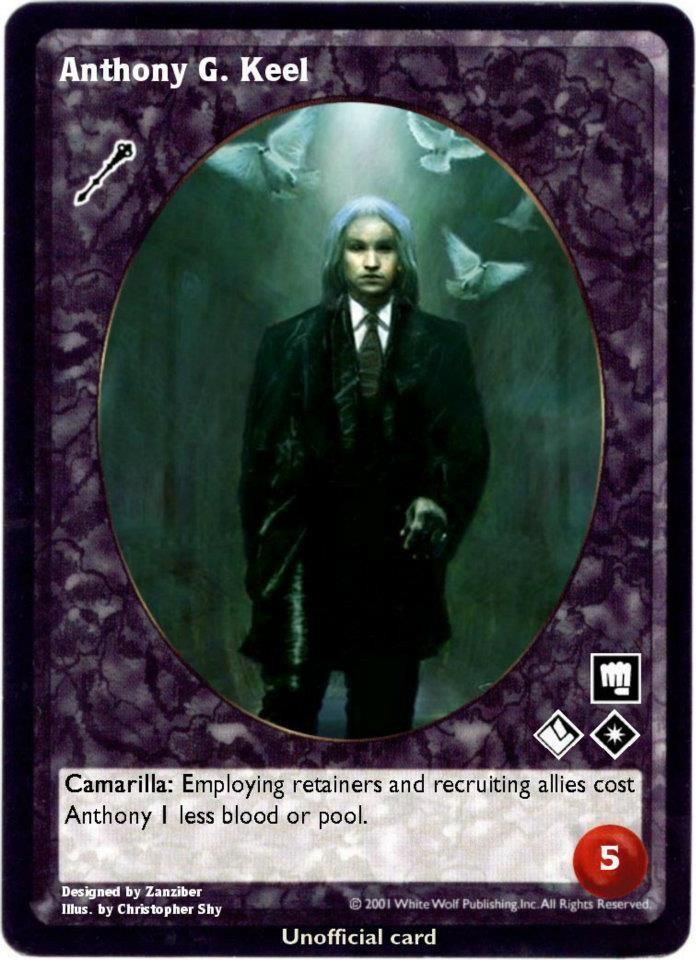
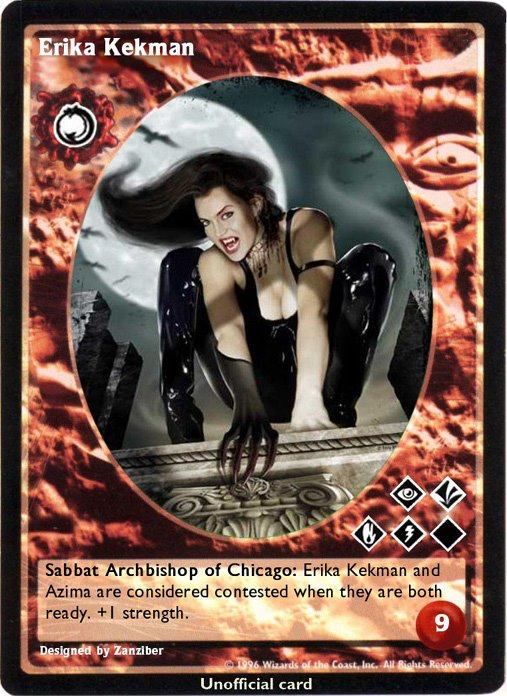
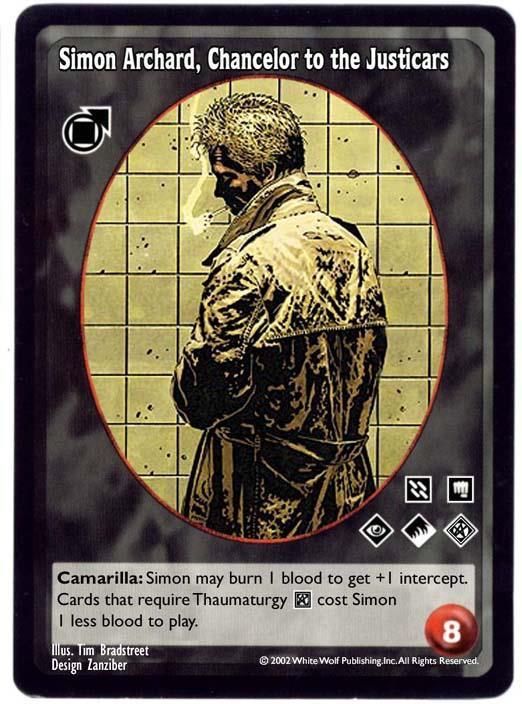
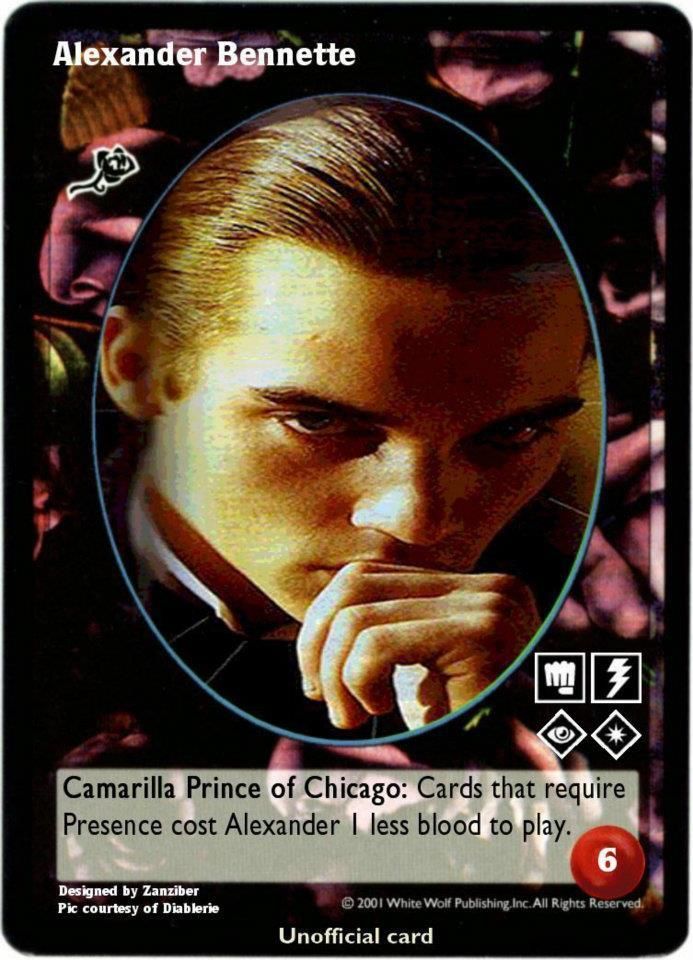
    When I was regularly playing Vampire: The Eternal Struggle, I found an interesting site that provided instructions for creating customized cards for the game. I thought this was a unique idea and went for a ride with it. I was able to create cards based on some of my past and present character in the various Vampire: The Masquerade games I've played... including the Camarilla LARP games. Here are a few of the cards I've designed based off my personal characters:


    Anthony G. Keel- This was one of my LARP PC's. He was a part of a large and somewhat infamous Ventrue family known as the Keel's. His backstory was that he used to be a member of the Giovanni family and was taken by his sire before he received the proxy kiss.


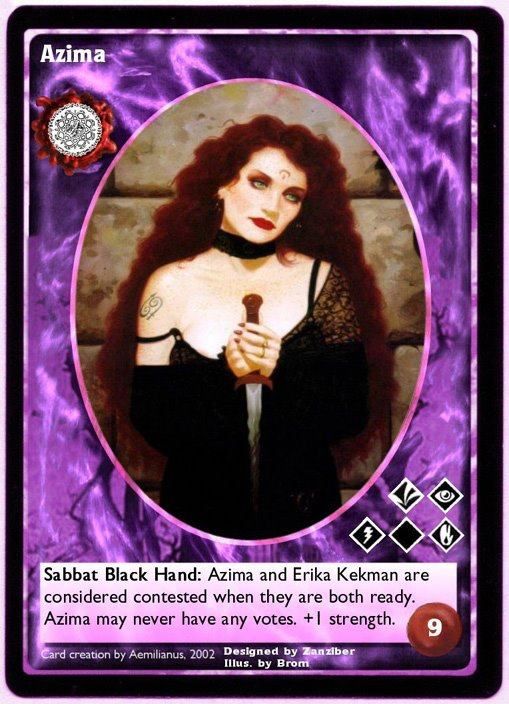
    Erika Kekman- Those people that know me know that my favorite vampire clan are the Tzimisce. Erika was an NPC I developed for a game with my ex-wife and some friends. As I recall, she quickly became a thorn in the side of all the PC's.


    Simon Archard- Probably one of my favorite character's from Vampire: The Masquerade. I have used him as an NPC in several of my tabletop games, and I'm currently working to develop him into a LARP character for the next Mind's Eye Society chronicle. There is a long story behind Simon, and I've recently decided to try and write his story for possible publication.


    Alexander Bennette- This is another of my NPC's from the same game that I used Erika in. You can see, from their respective titles, that I played Chicago as a contested city. Considering that one of the PC's was Alexander's childe, this provided a great deal of drama for the game.


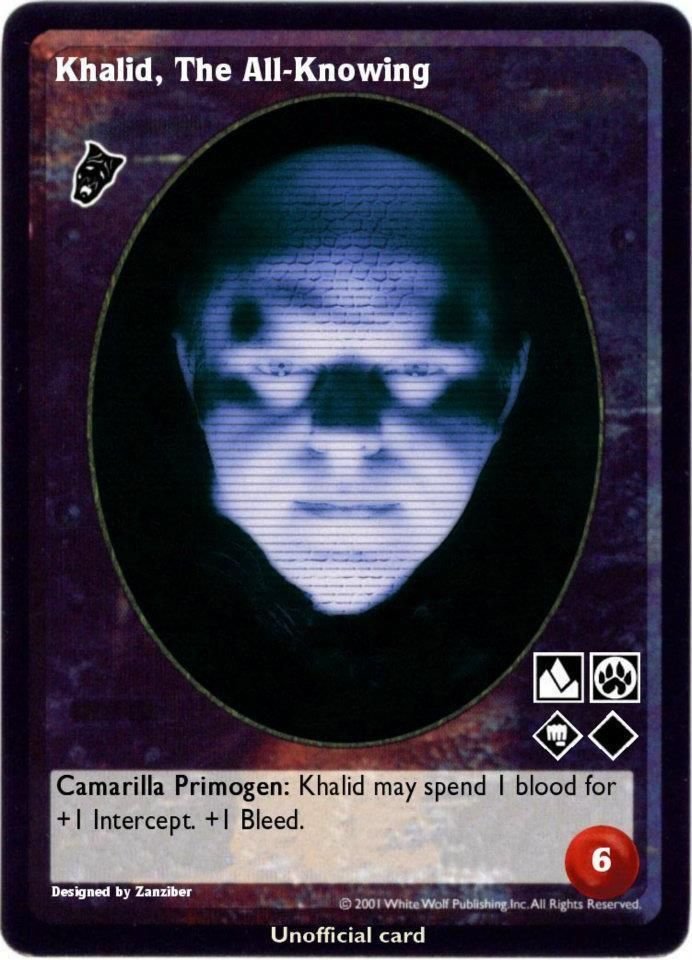
    Khalid- Another of my NPC's from the Chicago-based game. He became more of a key player in the political scene that I had originally intended. This was primarily due to Alexander's childe bonding with Khalid. A young Toreador bonding with a Nosferatu. If you know the clans, you'll understand the strangeness.


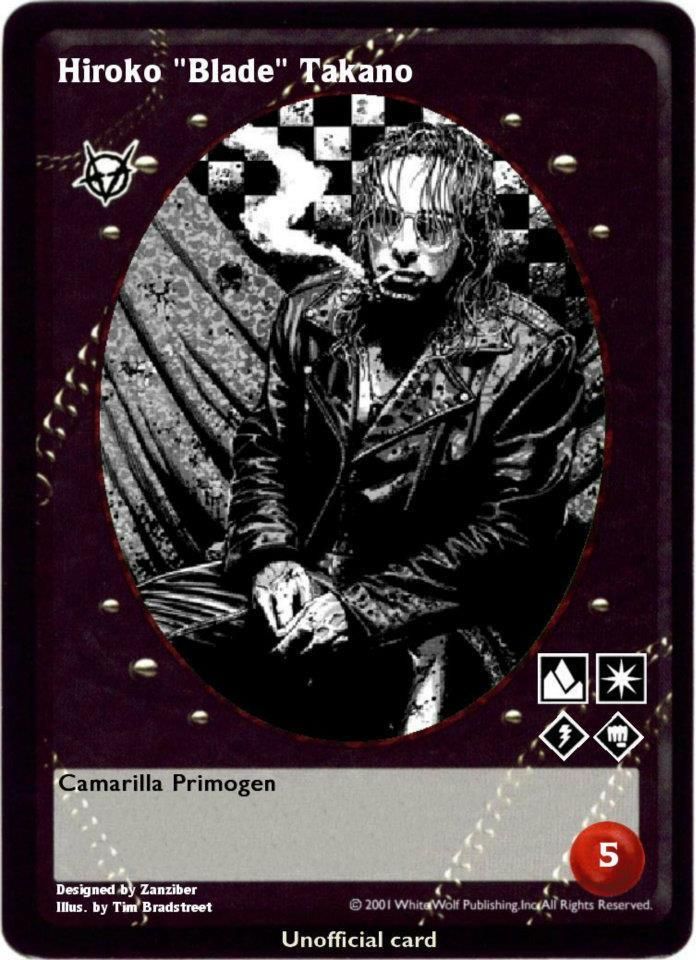
    Hiroko "Blade" Takano- For the Cam/Anarch side of things, "Blade" was probably my favorite LARP character in the Camarilla organization. I designed him as a weapons dealer, and with a couple of friends, we created the Takano family that spanned across the United States and even crossed venues. There were several Takano in the Cam/Anarch venue, but there were also numbers in Sabbat, Werewolf and even 1 Changeling. In time, I hope to again develop this Japanese family for use in the Mind's Eye Society.


    Dakota Black- This was my first actual LARP character. He originally was a Tremere, but was soon adopted into the Brujah clan to help save him from the Tremere. Playing Dakota was the best times I had before the 4.0 chronicle for the Camarilla organization. I traveled up and down the Willamette Valley to play this character. That was back when such inter-Domain gameplay was promoted. Now, there is very little reason... outside of getting together with friends in other cities... to travel for other games. This is one of the several reasons why I'm considering dropping LARP from my list of social obligations. We'll see.


    Azima- A counterpoint to Erika in my Chicago game. I'll be honest, I don't remember much about her character, but I do remember that the concept for her was based off of an old Dark Ages character I played.


    If you're interested in creating your own Vampire: The Eternal Struggle cards, this site is a great resource... even though it's out of date:


    Damnans' VTES Page

    Monday, December 31, 2012

    The Games We Play: Multiple Venues/Genres


    In the 80's, Palladium brought us a system with multiple universes (known as the multiverse), but they weren't actually connected. Then, in 1990, there was Rifts. This single game helped to bridge all the universes in the Palladium system under one big cosmological  convergence. Seasoned role players know Rifts well and there are many different viewpoints on it being a good thing or not. I for one am thankful for the invention of Rifts so that we could bring together concepts from different games together.


    For instance... in the 90's, my group of friends and I were avid players of the Palladium system and began to utilize Rifts as a way to bring together our favorite aspects from other games. We brought together elements from Robotech, Beyond the Supernatural, Heroes Unlimited, Teenage Mutant Ninja Turtles, Rifts and Ninjas and Superspies into a single world under the banner of being heroes, researchers and inventors. This was our sandbox, and it was fun.


    One of the biggest inventions that came from this sandbox was called the "Omega". It was a mashup between standard mecha and the Invid Royal Command Battloid. This was meant so that even "normal" humans could utilize it. I happen to have an artist rendering by the player who developed the actual idea behind it.


    In the 90's, White Wolf published... what is now know as... the classic/old World of Darkness. Vampire, Mage, Werewolf, Changeling and Wraith comprised the core of this new world, and as I was a long-time fan of the supernatural, of course these games became quick additions to my collection and our playgroup.


    The great part of the World of Darkness is that you can play each game separately, or combine them together for the rich feel that Mark Rein·Hagen and the other developers had in mind. As much as they can be played separately, I feel that they are better combined. This is something that has been lost on the powers-that-be who develop the live action rules for the Mind's Eye Society, who seem to prefer to keep each game separate.


    Sure, Dungeons & Dragons has their different settings such as Dragonlance, Forgotten Realms, Dark Sun, Ravenloft and so on. I never felt that inter-setting travel was not something that TSR and WotC had in mind... even though they do have inter-planar travel. I know there have been some DM's (myself included) that allowed for the inter-setting travel. This just helps to promote the rule of all RPG's that the no matter what the rules in the books state, the DM/GM/ST has final determination in their games.

    Tuesday, December 25, 2012

    The Games We Play: Mortal Campaign


    Over the years, my group of friends and I have gone through several variations of plot for our campaigns. I'm going to illustrate these various campaigns so that it may help to inspire you to try and think outside-the-box when coming-up with your next campaign idea.


    Our first variation began around 1999 when our games began to get a little stagnant and one of the storyteller types in our group decided to do something out-of-the-ordinary. This became one of my favorite concepts for future games.


    In the original mortals campaign, each of us created mortal characters in the original World of Darkness setting based on our real life. Yes, our characters turned-out to be us. We voted as a group to determine how many dots each character received for their abilities and attributes. We also used the group to determine things like willpower, merits and flaws for the characters as well.


    The storyteller had setup a system to determine the possibilities for what our characters would become while traversing in the World of Darkness. (i.e. Vampire clan, Werewolf tribe/auspice, etc.) This information was kept quasi-secret from the players... but we each had our suspicions for each player. For example, because of my interest and skill with a computer, it was assumed that my character would likely become a Virtual Adept Mage. The first campaign I recall actually being embraced as a Brujah by one of the other PC's.


    Another interesting aspect of this game was that our knowledge of the various games in the World of Darkness transferred into the corresponding lore. (i.e. Vampire Lore, Mage Lore, Werewolf Lore, etc.) This made for some cumbersome but fun interactions for our characters as we had foreknowledge of events through meta-plot. For instance, the aforementioned PC that embraced my character sought out a Methuselah Brujah in Chicago by the name of Menele... who just happens to be of the 4th generation. Also, in the hopes of awakening as a Virtual Adept, I remember actively trying to contact the archmage Virtual Adept known as Dante. Good times.


    One variation that I ran utilizing the Dungeons & Dragons 3.5 rules was very interesting. I had the players make standard characters, but when the game began I stated that each of us were about to get ready for a game of D&D in character... breaking what could be called the fourth wall of role playing. As the "characters" were ready to begin the story, my "character" left for the bathroom... and it was at that time I employed the time honored DM tool of "there's a bright flash, and you wake-up somewhere else." When they each woke-up, they were in their character's bodies... yet they still retained their player knowledge. I guess you can say I enjoy using the meta-game to my advantage.


    After being a storyteller and player for so many years, I've developed a great many PC's and NPC's that I appreciate using in my games. In my D&D version of the mortals campaign, I decided to use characters each player could somehow relate to by utilizing characters that each of us had played in our LARPing days. This added another level of interest for the players, and a good time was had by all.

    Monday, December 17, 2012

    My Experiences as a Member of the Camarilla/Minds Eye Society


    I've already written about my time in Live Action Role Playing games, but I wanted to delve a little deeper into it as what I posted was more a brief summary of my experience rather than specific thoughts, feelings and moments.


    When I first joined the local Camarilla, I was given my first opportunity to learn about the organization by becoming the Assistant Chapter Coordinator (ACC) for my chapter; Ascending Twilight. This also helped me to progress in the organization by earning "prestige"; the magical number that is followed to show your elevation in the organization by your assigned Member Class or MC. I thought this was great and jumped at the chance to earn as much prestige as possible. That was in 1996. Today, in 2012, the system has changed quite a bit but has also remained the same. I've been waiting for my MC review that has been sitting at the Regional level since about August. There is apparently some problem with the prestige reporting from 1996 - 1998. I'm not entirely sure what's going on right now, but I'm also in a position of not to complain or worry about it too much. I anticipate losing about 1 1/2 years worth of prestige that I earned while I was the Chapter Coordinator (CC) for Ascending Twilight because of this reporting error.


    After a few months of being an ACC, I thought that I could do more but also wanted to spread my wings as a creative role players. That's when I first started down the path as a Storyteller (ST) for LARP.


    In 1997, the organization decided to make some changes with the rules and reset the current campaign setting, or chronicle. This means that we began with a clean slate and new characters. Everything we had accomplished with our previous characters had no impact on what was going to happen in the new story. This gave me the perfect opportunity to begin as an ST, and we needed a new Domain Storyteller (DST). I won the election and there we were.


    I knew that I couldn't handle the games all by myself, so I enlisted the aid of a couple friends, who became my Assistant Domain Storyteller's (ADST's). There were also Chapter Storytellers (CST's) to represent each Chapter in the Domain. We were full of ST's and ideas and this made the Domain a fun place to play. I was DST for about 7 months, and then something happened.


    In those days, we didn't have the resources like Google Drive or Wiki's that we do now. I spent the 7 months of my term as DST trying to get answers to so many questions:


    • What was the proper format for my monthly reports?

    • Was there a report template for these reports?

    • Who/where do I send the monthly DST reports?

    • What all should I add in my monthly report?


    Because I never received answers to these questions, it looked as though I wasn't doing my job. Also, important items that (I learned later) should be on my report were missing, and this became the inevitable downfall to my term as DST.


    At one of our normal games, we received a large influx of out-of-town players that we were unfamiliar with. They were signed-in and we played game. (I should note that our games started at around 8pm and could last into the wee early hours of the morning.) At around 11pm, one of the out-of-town players shouted "Time out! Who is the DST? I need to speak with him." I came up to find out what the problem was and was informed that he was the Assistant Regional Storyteller (ARST) and he had some serious items to discuss with me. He, and 2 other ARST's, took me aside and began to berate me about certain item's that I had allowed to happen, such as:


    1. I allowed the diablerie of a Player Character (PC) happen without reporting it... even though I was not informed I had to do so. (Please see the definition of diablerie for more information.)

    2. I did not take serious action against the PC who committed the diablerie, even though doing so would have taken my out-of-character knowledge and brought it in-character.

    3. I did not personally verify characters that were brought into play from the 3 ARST's. Each of the ST's took responsibility for conducting sign-in. This was not a time where it was my responsibility and the ARST's apparently brought in characters that should not have been allowed in play.


    I think the biggest mistake I made that evening was not allowing my ADST's to join in the "conversation" I was having with the ARST's. At the end of the very public chastising, I was told that I would no longer be the DST. This was my first instance of dissolution in the organization as I felt very mistreated by members of the Regional Storyteller staff. Life went on.


    For the next several years, I would be a Coordinator and I would be an Assistant Storyteller, but until I returned in 2011, I would not hold a primary Domain position again. I think that this benefited me as others helped to define the basis of whatever reports were necessary. I'm thankful that today there is a defined process and even some templates that can be used for reports, and the scope of responsibilities for both the Storyteller and Coordinator offices are easier to understand.


    After a personal setback in January 2000, I felt like I didn't fit-in with the people that I had literally grew-up with in the organization. Even though I was given responsibilities, I felt like I was looked down upon for mistakes I had made. I felt betrayed by several of the people I once called friend. This lead to my eventual departure from the Domain of Salem and joining the Domain of Dreams in Eugene.


    I thought I could start new in Eugene, and it was working out fine until I was put into the position of Chapter Coordinator. There were decisions that had to be made, and I was not the person who should have been making them at that point in my life. I let people's opinions cloud my better judgement, and through that I made some bad decisions. I think I was CC in Eugene for about 3 months before I had to step away. I kept playing for a while longer until certain people started to bend the rules of the game way too much.


    I'll admit that I put in a great deal of work when I create a character for these games. Because of this, I have felt personally slighted when people abuse the rules to manipulate me or (especially) to kill-off character's that are close to me and my character. This happened with my pack in our Sabbat game. Our pack was seemingly causing too much of a problem with certain people, so one of the players played a non-player character (NPC) that was specifically designed to kill our leader.


    The way it was handled bent the rules of the discipline (power) called Vicissitude. This power allows the wielder to manipulate flesh and bone, however you need to actually use your hands to do so. The flesh and bone does not simply move to your whim and you cannot make yourself into a pile/pool of flesh with other disciplines or a certain combination discipline. Either way, the NPC could not (by the rules) drape them self over another person, yet this is what happened and our packs leader died. Shortly after this exchange, I decided to take a long sabbatical from the organization.


    From 2004 - 2011, I stayed in contact with only a few of the friends that I had made while in the Camarilla. Without social networking sites like MySpace or Facebook, I probably wouldn't be in contact with many of them now... or vice-verse. Of the friends I made during my original tenure within the organization, I only have regular contact with a handful of people. Now that I'm back with the new organization, I occasionally get a chance to meet-up with old friends and reminisce about the old days.


    Now it's 2012. The organization has changed quite a bit. It's now called "Mind's Eye Society"... at least in America. I don't feel as much of the camaraderie with other Domains as I once felt. Early on, there were week's where several of us would go to Oregon City, Portland, Vancouver, Corvallis, Eugene and still make it to the Salem games. This helped to breed an air of companionship, friendship and trust. It feels like that aspect has been lost to us. Back then, our core local group would host regular tabletop games and other social activities. Now it feels hard to get anyone motivated to do anything fun.


    Maybe it's because I've done a lot of growing-up since those days and now that I feel like a responsible adult (some days), I feel like I don't have much time to take on extra activities. Perhaps this is a feeling that is shared with others. We're responsible adults now and not fun-loving youths able to stay-up until the wee hours of the morning talking, playing games, hanging-out at Denny's and the like. Perhaps what I'm feeling... and perhaps others... is the horrible side-effects of getting old. We are not as young as we were in 1996. Some of us aged more than others during that time.


    There's talk about a new chronicle starting in 2013 and how the organization is going to make some major changes to the different games. There's talk about keeping the Camarilla and Sabbat in separate "universes", making a New World of Darkness venue and capping MC for certain venues to try and level the playing field. I'm not actively a participant in these talks so I'm very frustrated when I hear of new changes and I can't express my opinions on the ideas to the proper individual's. While I understand the reasons behind things like MC capping, the games I play are collectively called the "World of Darkness". It's not the World of the Camarilla or the World of the Sabbat. The system was originally setup to incorporate ALL aspects of the various games; from Vampire to Hunter and everything in between. If it's not the World of Darkness, then why am I paying an annual membership fee to be here?


    I apologize that this ended in a bit of a rant. In writing this, so many emotions came flooding back to me. I hope you understand that I'm merely stating my opinions and I, just like you, have the right to express them. If you disagree with anything I've written, I welcome your feedback. Fair warning: I took speech and debate in high school, and I was fairly good at it. :)


    Thank you for reading.

    Marvel Masterworks: Amazing Spider-Man Vol. 2

    Title: Marvel Masterworks: Amazing Spider-Man Vol. 2 ISBN: 9780785136941 Price: $24.99 Publisher/Year: Marvel , 2009 Artist: Steve Ditko Wri...